If you’re just joining us on this journey, welcome! We are so grateful for the support and love during this ever changing situation. We’ve been navigating a whirlwind of emotions. We’re leaning on hope, faith, and science. Our family faces something we never expected—Ross’ diagnosis of uveal melanoma, a rare and serious form of eye cancer.
Ross Wither is the heartbeat of The Traveling Withers. He is a stay-at-home dad to our four kids, ages 14, 10, 5, and 3. He’s the one who keeps our world running smoothly. Earlier this year, he went for what we thought would be a routine eye exam. Through three appointments, two in Louisiana and one in Texas, we received devastating news. Ross had a detached retina caused by a mass… a large tumor in his right eye. On August 30th, 2024, “Lenny”, the tumor, measured 17.5 mm x 6.2 mm. The doctor told Ross: “We’re going to try to save your life, then your eye, then your sight.”
Hearing the words ‘eye cancer’ shook us to our core. Reality changed in an instant. What did it mean for Ross’ health? How would our family move forward? Does Ross have liver or lung cancer? Has the cancer metastasized anywhere else? Uveal melanoma happens to less than five people in a million. According to BreastCancer.org, “Approximately 1 in 8 women (13%) in the U.S. will develop breast cancer at some point in their life… In 2024, approximately 310,720 women will be diagnosed with invasive breast cancer.” According to Cancer.gov, “In the United States, approximately 1,700 people are diagnosed [with uveal melanoma] each year.” Uveal melanoma is very rare and there has been limited research comparatively to other types of cancers.
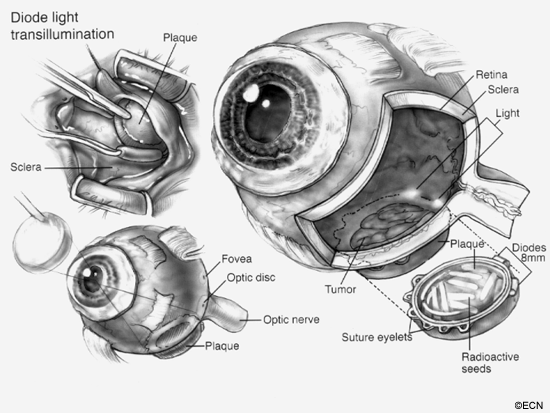
The first recommended treatment was plaque brachytherapy. This is a type of radiation where a solid gold radioactive plaque is temporarily sewn onto the eye. The “seeds” of radiation target the tumor directly, creating an unwelcome environment where it would cease to thrive. We were ready to get the surgery done in mid-September but as it turns out, God had other plans. The anesthesiologist didn’t clear Ross for surgery due to a cold. “Lenny” was remeasured, we got breakfast in Houston instead of surgery, and regrouped. As it turns out, we found out a few days later, “Lenny” had grown. Ross’ tumor was now measuring one millimeter wider at 18.5 mm x 6.2 mm. Because of the tumor’s size, Ross would now need two plaques. That meant two separate surgeries. It also means four times under general anesthesia, two periods of quarantine, and all of this happening through out-of-state care. It felt like a mountain to climb.
Then, we learned about a clinical trial in for a drug called Darovasertib. This drug has shown promise in shrinking localized and metastasized uveal melanoma tumors. If Ross’ tumor shrunk, it would mean less radiation or even needing only one plaque instead of two. This trial gave us hope—a potential way to reduce the severity of treatment. We connected with others in a support group. They had seen positive results from the trial. One person shared that their tumor shrank by 2 mm in just four weeks. It was the first glimmer of light in a very uncertain time.
Things didn’t go as smoothly as we hoped. Ross’s insurance didn’t cover the out-of-state care in-network we needed for the trial. We wanted our first choice hospital due to its proximity to friends. That would have made it easier to send Ross for treatments alone. We are trying to secure a GAP exception. This would let our insurance bill us for the doctor’s visits at in-network rates. The reason is that the care is 75 miles and more from our home. However, we continue to hit roadblock after roadblock. We even considered paying thousands out of pocket just to get Ross into the trial. The financial stress and uncertainty can be overwhelming at times.

Through all of this, we stayed strong. We decided to move ahead with the original plan of plaque brachytherapy if the trial didn’t work out. However, we continued to hope and pray that we would make the Darovasertib trial a reality. We took action and emailed all the contacts we could find for the clinical trial. As a result, in early October, we secured Ross appointments at the Mayo Clinic in Rochester, Minnesota.
Most recently, Ross had an eye biopsy and met the wonderful team at Mayo Clinic, including Dr. Lauren Dalvin, who has been incredibly kind and supportive. We are still waiting for final answers and the feedback from his genetics testing. We’re hopeful that Ross will soon begin the Darovasertib trial. This trial could be a game-changer. Ross travels alone to Minnesota in a week. We will return together in November for his next treatments and scans.
In the midst of it all, we’ve found moments of joy. Our trips are a mix of treatments and time to recharge together. These trips have given us moments of laughter and connection in the heavy reality we facing. We’ve also been diving into ‘Doc Movies’—action-packed flicks like Godzilla vs. Kong and Jurassic Park. They help us escape for a little while. Reminding us that even in tough times, there’s still room for fun.
Looking ahead, we know there are still challenges. Ross will likely lose vision in his right eye within the next 12 to 18 months after plaque brachy therapy. We’re taking each day as it comes. We are leaning into hope, faith, and the power of modern medicine. We’ve been so touched by the love, prayers, and support from our friends, family, and community. Every prayer has uplifted us. Every word of encouragement has supported us. Every donation through GoFundMe or Venmo (@Megann-Wither) has helped us in ways we can’t even describe.
If you’re just joining us on this journey, or if you’ve been watching since the beginning, here’s where we stand. We are filled with hope. We are committed to journeying together. We are forever grateful for the support around us.
With love and so much gratitude,
The Traveling Withers
 thetravelingwithers.com
Share Your Thoughts!